
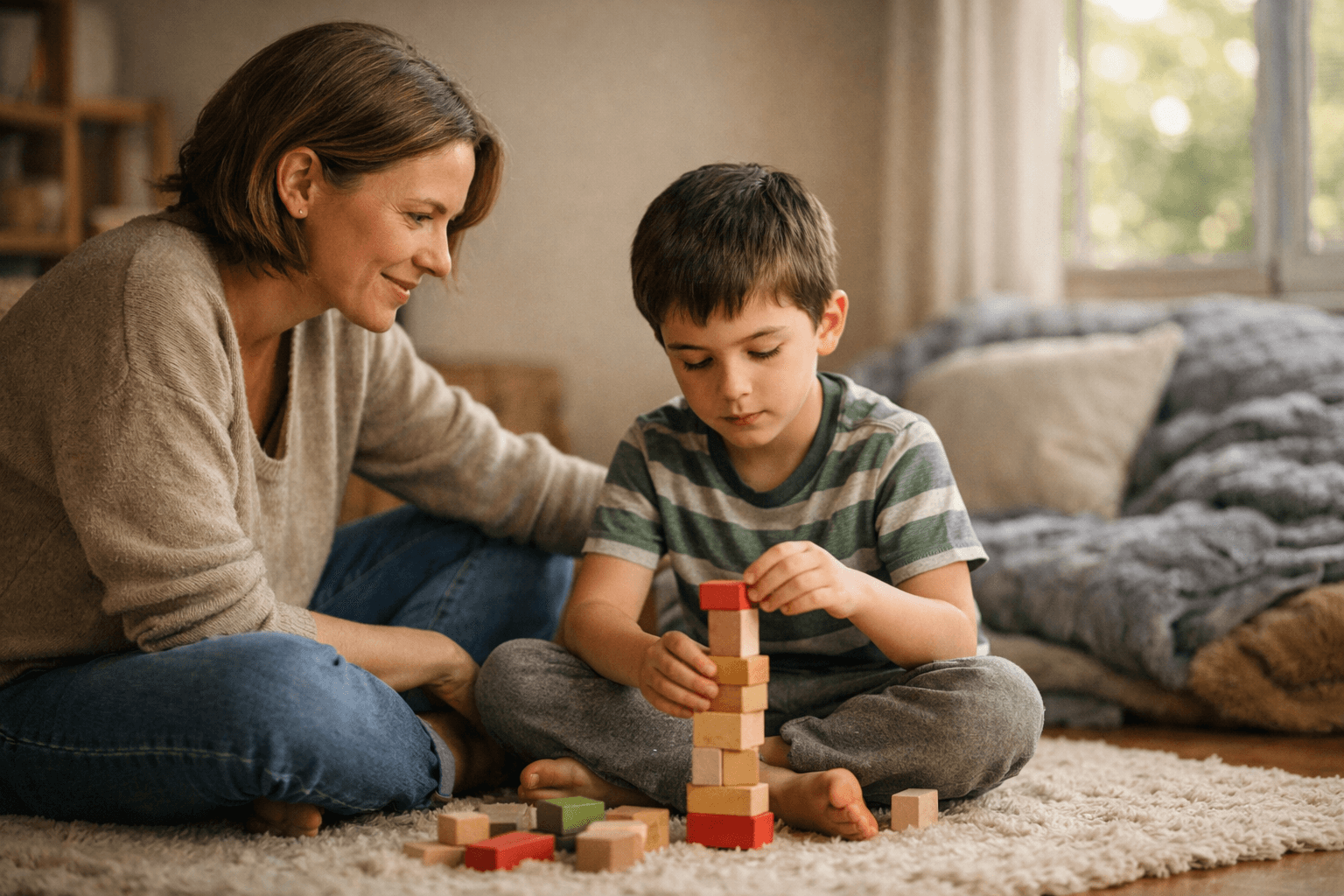
When Support Feels Safe: Building Trust with Autistic Children
Noam Hope
Noam Hope Consultant
“Does your child feel safe being fully themselves at home?”
There is a difference between support that is technically correct and support that actually feels safe.
Autistic children do not thrive because someone has a checklist of strategies. They thrive when the adults around them become predictable, respectful, and emotionally attuned. Safety is not just physical — it is nervous-system safety. It is the feeling of being understood without needing to mask, perform, or explain yourself constantly.
What Safety Really Means
When we talk about safety in a neurodiversity-affirming home, we’re talking about:
Emotional predictability
Clear communication
Respect for sensory needs
Freedom from constant correction
Space to regulate without shame
Many autistic children live in environments where they are frequently redirected, corrected, or misunderstood — often unintentionally. Over time, this can create hypervigilance.
A child may appear “defiant” or “withdrawn,” when in reality their nervous system is bracing for overwhelm.
Safety reduces that bracing.
And when the nervous system is not in defense mode, learning, flexibility, and connection become possible.
The Nervous System Comes First
Before focusing on behavior, routines, academics, or even nutrition — start with regulation.
An unregulated nervous system cannot access logic, language, or coping skills. This is true for adults and children alike.
Here are three foundational ways to support regulation:
1. Predictable Rhythms
Autistic children often experience the world as intense and fast-moving. Predictable routines create relief.
Visual schedules, consistent morning and evening rituals, and advance notice of transitions reduce anxiety dramatically.
Predictability builds trust.
2. Sensory Respect
Some children need movement to regulate. Others need quiet. Some crave deep pressure; others avoid touch entirely.
Instead of asking:
“How do we stop this behavior?”
Try asking:
“What sensory need might be underneath this?”
Meeting sensory needs is not indulgence — it is neurological support.
3. Co-Regulation Before Independence
Self-regulation develops through co-regulation.
When a calm adult sits nearby, breathes slowly, lowers their voice, and offers presence without pressure, the child’s nervous system gradually synchronizes.
Independence grows from felt safety — not forced coping.
Moving from Correction to Curiosity
It’s easy to slip into constant correction:
“Use your words.”
“Calm down.”
“That’s not appropriate.”
“Look at me when I’m talking.”
But curiosity changes everything.
Instead of correcting immediately, try:
“What’s happening right now?”
“Is something too loud or too fast?”
“Do you need a break or help?”
Curiosity communicates respect.
Respect builds trust.
Trust creates openness.
And openness allows growth.
Strength-Based Environments
Autistic children often receive more feedback about what is “wrong” than what is strong.
But when families actively name strengths — deep focus, honesty, creativity, memory, pattern recognition, empathy, loyalty — something shifts.
A child who feels valued for who they are does not need to defend themselves constantly.
At home, this might look like:
Making space for intense interests instead of limiting them unnecessarily
Displaying projects proudly
Allowing different communication styles
Celebrating small progress, not just big milestones
Strength recognition isn’t flattery.
It’s identity building.
When Parents Feel Overwhelmed
Supporting an autistic child can be beautiful — and exhausting.
If you feel stretched thin, that does not mean you are failing. It means you are human.
Parents need regulation too.
Small practices help:
5 minutes of quiet before responding during conflict
Shared responsibility between caregivers
Gentle expectations instead of perfection
Asking for professional guidance when needed
Support works best when the whole family feels steadier.
The Long View
Building a safe, regulated home environment is not about eliminating every meltdown or struggle.
It’s about reducing shame, increasing understanding, and creating conditions where your child feels:
Seen
Heard
Accepted
Protected
From that foundation, everything else becomes easier — communication, nutrition shifts, school advocacy, social growth.
Safety is not a strategy.
It is the soil where every other strategy grows.
If you’re unsure where to begin, start small.
Choose one predictable routine.
Create one quiet space.
Practice one curious response instead of correction.
Change rarely happens through force.
It happens through safety.
And safety is something we can build — gently, consistently, together.
Related articles
Understanding Sensory Needs in Everyday Life
Sensory processing differences affect how many autistic individuals experience the world. Learn prac…
Transitioning to Adulthood with Confidence
The transition from adolescence to adulthood is complex for everyone — and requires thoughtful, indi…